

Blank walls are the hardest part of decorating any room. Wainscoting and wallpaper solve that problem together, with panelling bringing structure and shadow to the lower half of the wall and wallpaper carrying colour and pattern across the top. Neither has to do all the work alone, which is why the pairing suits rooms that feel either too plain or too busy.
This guide covers what wainscoting is, how to spell it, whether it still looks current, and what it actually does to the proportions of a room. From there you will find the seven panelling types worth knowing, each with a wallpaper pairing, followed by room by room ideas with practical tips for each, a step by step on installing it, and how to decide between a mural and a repeating pattern above the panels.
What Is Wainscoting?
Wainscoting started out in the 18th century as a wall covering used to help insulate a room and provide a more durable surface than a painted wall.
Now it is mainly used as decorative accent panelling that usually covers the lower half of your interior walls, adding architectural interest and protecting the wall from scuffs, chair backs and skirting-height knocks.
Is It Wainscoting or Wainscotting?
Both spellings turn up, and both are widely understood. Wainscoting, with one t, is the standard spelling in British and American dictionaries and the one most people search for. Wainscotting, with two, is a common variant that appears across plenty of interiors sites and supplier listings.
The word itself comes from the Middle Dutch wagenschot, a term for fine-grained oak boards used for panelling. If you are writing a brief for a carpenter or searching for products online, one t is the safer choice. Either way, you will end up looking at the same panelling.
Is Wainscoting Still in Style?
Yes, though what counts as current has shifted. The heavily moulded raised panel that once defined the look has given way to simpler profiles, and the way panelling is finished matters more now than the profile itself. Three habits separate panelling that looks considered from panelling that looks dated:
- Paint it the same colour as the wall above. A white panel below a coloured wall is the combination that reads as dated fastest. Matching the two turns the panelling into texture rather than a contrast band.
- Take it higher than tradition suggests. Panelling no longer has to stop at a third of the wall. Two-thirds height, or up to a picture rail, feels far more current and gives a wallpaper above it a defined band to sit in.
- Put something above it. Panelling below plain emulsion is where the look falls flat. Wallpaper above is what gives the panelling a reason to be there.
One practical test before you commit: match your panel colour to your skirting boards and door frames rather than to your ceiling. It keeps the joinery in a room reading as one piece.
Does Wainscoting Make a Room Look Smaller?
Usually not. Where a room does feel smaller afterwards, the cause is almost always the height of the rail rather than the panelling itself. A few specifics worth knowing before you mark up a wall:
- Avoid the exact midpoint. A rail at half the wall height splits the room into two equal bands, and that is the one proportion that genuinely flattens a space. Set it at roughly one-third of the wall height from the floor, or take it up to two-thirds, but not the middle.
- Use vertical grooves in a low room. Beadboard and tongue and groove run vertically, so they add perceived height rather than taking it away. Flat shaker panels sit more neutrally.
- Paint panel and wall the same colour to remove the line entirely. With no tonal break at the rail, the eye reads the wall at full height.
- Go darker below, lighter above. A deeper panel colour under a pale wallpaper makes the lower wall recede and the ceiling feel further away.
- Be careful in narrow hallways. Panelling on both facing walls can close in a corridor. Run it on one wall only, or keep it low, under about a third of the wall height.
Wallpaper above the rail helps here too. A design with vertical movement, such as trailing stems or stripes, pulls the eye upward and does more for a low ceiling than panelling alone.
Different Types of Wainscoting
Wainscoting is both decorative and functional, giving a wall visual structure while protecting it from daily wear. Each type carries a different mood, and each one suits a different kind of wallpaper above it. Here is how the seven most common styles behave in a real room.
Shaker or Flat Panel Wainscoting
Clean lines and square frames give shaker panelling a quiet, timeless look that sits comfortably in modern and period homes alike. The flat centre panel casts almost no shadow, so it stays in the background and lets whatever you put above it lead. That makes it the most forgiving type to pair with a bold or large-scale wallpaper. Keep the frame width narrow, around 50 to 70mm, if you want it to read as contemporary rather than traditional.

Featured: Forest Engraving, Nature Mural Wallpaper
For more designs with this kind of restraint, browse our Scandinavian wallpaper collection.
Board and Batten Wainscoting
Board and batten uses narrow vertical strips laid over a flat base, creating a grid of tall rectangles. The rhythm it sets up is stronger than shaker, so it works best under a softer or tonal wallpaper that will not compete with it. Spacing is what makes or breaks this one: battens set roughly 400 to 500mm apart look deliberate, while wider gaps start to look like an afterthought. If the carpentry is out of budget, our Shiplap, Vertical Striped Wallpaper applied to the lower half of the wall gives a similar vertical rhythm for a fraction of the cost.
Browse more designs with vertical movement in our striped wallpaper collection.
Beadboard Wainscoting
Beadboard is made up of evenly spaced vertical grooves, each separated by a small rounded bead. The repetition gives it a cottage and farmhouse character that suits bedrooms, kids' rooms and utility spaces particularly well. Those vertical lines are also the reason beadboard is the best choice in a room with a low ceiling. Left in natural timber it brings warmth that painted panelling cannot, and it pairs happily with florals, ginghams and hand-drawn motifs above.

Featured: Apple Barn, Animal Pattern Wallpaper
Find more designs for little ones in our kids wallpaper collection.
Raised Panel Wainscoting
The most ornate of the group, raised panel features a bevelled centre panel that sits proud of its frame, throwing a real shadow line. It belongs in period homes and formal rooms, particularly dining rooms and entrance halls with generous ceiling heights. Because the panelling is already doing a lot, keep the wallpaper above it restrained: damasks, tonal botanicals and aged or vintage-effect designs sit better here than anything graphic.
Explore period-inspired designs in our vintage wallpaper collection.
Tongue and Groove Wainscoting
Tongue and groove uses interlocking boards that slot into one another, giving a flatter, wider-grooved finish than beadboard. The look is relaxed rather than formal, which is why it reads as coastal, Scandinavian or farmhouse depending on how it is painted. It also handles humidity better than most panelling when properly sealed, making it a sensible choice for bathrooms and laundry rooms. Pair it with calm mural scenes or soft natural patterns for a grounded, unfussy room.
See more in our coastal wallpaper collection.
Tile Wainscoting
Tile is an often overlooked form of wainscoting, and it is the most practical one in a kitchen or bathroom. Run to dado height and finished with a timber or metal cap rail, it protects the wall from splashes and keeps the wallpaper above well clear of water. Square metro or subway tiles are the usual choice, and a contrasting grout will make the tiling read as a deliberate band rather than a backsplash that got carried away. This is the pairing that makes wallpaper viable in rooms where you might otherwise rule it out.
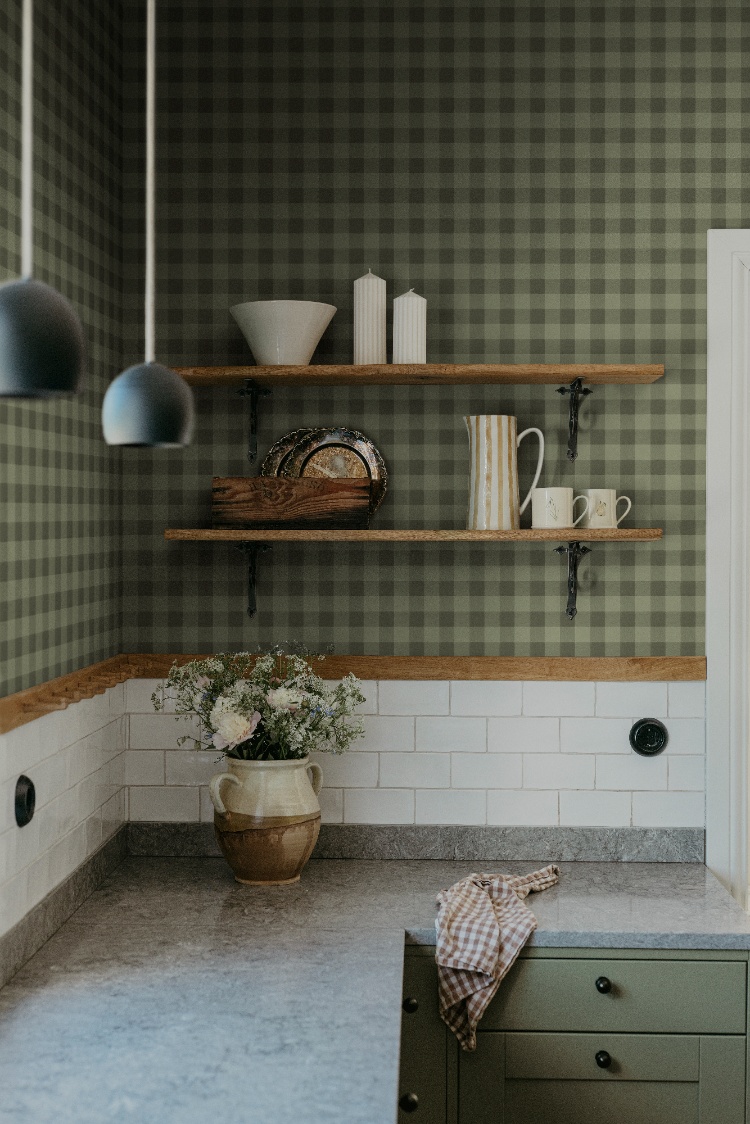
Featured: Harry Checkered, Pattern Wallpaper
See how this works in a wet room in our guide to modern bathroom wainscoting ideas with wallpaper inspiration.
Chair Rail Only
The simplest option of all skips panelling entirely and runs a single moulded rail around the room, with plain painted wall below it. There is no joinery to build, the cost is a length of moulding and an afternoon, and it still gives a wallpaper above a clean edge to finish against. It suits rooms with strong architecture already in place, and it is the right call when you want a mural to be the only thing anyone notices. Keep the rail slim and paint it into the wall below for the most current version of this.
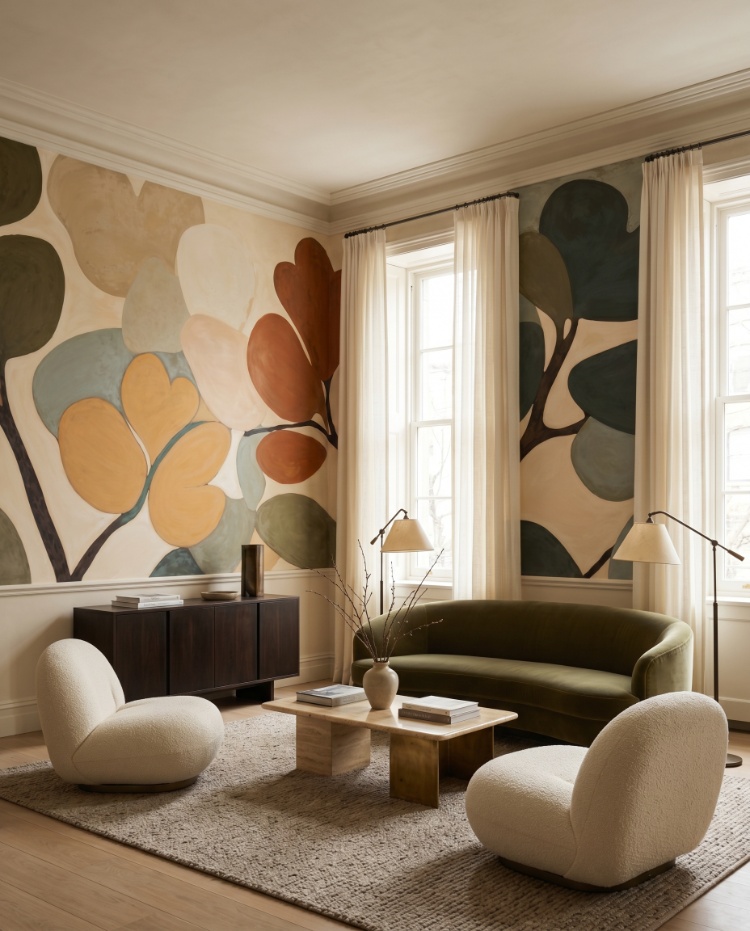
Featured: Emil's Bouquet, Abstract Mural Wallpaper
Browse designs made to be the focal point in our mural wallpaper collection.
Wainscoting Design Ideas for Every Room in the Home
Wainscoting is a versatile wall treatment that blends beauty with practicality, which is why it works in almost any space in the home. From adding architectural detail to protecting walls in busy areas, it can be tailored to suit different rooms and styles. Here is where it earns its keep:
- Dining Room. Adds a touch of formality and elegance, creating a refined backdrop for entertaining.
- Living Room. Frames the walls beautifully, offering texture and architectural interest to main gathering spaces.
- Hallways. Protects high-traffic areas from scuffs and marks while elevating visual appeal.
- Bedrooms. Introduces a cosy, classic feel that pairs well with both traditional and modern décor styles.
- Kid's Room. Offers durability against bumps and scratches while adding a charming, playful touch.
- Kitchen. Brings warmth and style while guarding walls from splashes and daily wear.
- Bathroom. Adds character while providing a water-resistant barrier, especially useful in humid environments.
- Home Office. Enhances a professional yet inviting atmosphere, making the space feel more polished.
- Staircases. Creates continuity and style while protecting walls along heavily used routes.
Wallpaper is a great way to add pattern and texture to any of these spaces. Choose a design that coordinates with your panelling and use it to accentuate the architectural details already in the room. Here are some of our favourite wainscoting and wallpaper pairings, room by room, with the practical points worth settling before you start.
Wainscoting and Wallpaper for the Living Room
With a little bit of creativity, wainscoting and wallpaper can transform your living room into a stylish and inviting space. Pair our Cross Stitch, Pattern Wallpaper with this classic panel treatment to make your space pop.

Featured: Cross Stitch (HelloCircus x HouseofChais), Wallpaper
If the carpentry is too pricey, a cost-effective alternative for panelling is to use wallpaper instead. Our Shiplap, Vertical Striped Wallpaper is a classic, timeless and versatile design, and it comes in 6 colourways. It can be applied to the top, the bottom, or the entire wall. Applied to either the top or the bottom, it creates a panelling-like effect that is genuinely convincing from across a room.

Featured: Shiplap, Wallpaper
Three things worth settling before you start in a living room:
- Measure your sofa before you mark the rail. Set the top rail just above sofa-back height, which is usually somewhere between 900mm and 1m, so the back of the sofa does not slice the panelling in half. Low-backed modern sofas let you drop the rail further.
- Sort the sockets and TV points first. These almost always land at dado height. Plan the rail to sit clearly above or below them rather than cutting through, and move any TV cabling before the panels go up, because chasing cable through fitted panelling afterwards means taking it off again.
- Panel the whole room, paper one wall. If budget is tight, run the panelling and rail all the way round and wallpaper only the chimney breast or the wall behind the sofa. The continuous rail carries the eye around and makes a single papered wall look deliberate rather than unfinished.
Discover more living room wallpapers that reflect your personal style and help create a warm, welcoming atmosphere your whole family will enjoy.
Wainscoting and Wallpaper for the Bedroom
Combining wainscoting with wallpaper in the bedroom creates a layered, sophisticated look that blends texture with pattern. Panelling along the lower portion of the walls offers a timeless frame that grounds the space, while wallpaper above adds personality, whether through soft florals for a calming retreat, geometric prints for a modern edge, or nature-inspired designs for a cosy, organic feel. The pairing is practical too. Panelling takes the scuffs and marks from bed frames and bedside tables, and the wallpaper draws the eye upward, making the room feel taller.

Featured: An Old World Arboretum, Watercolour Mural Wallpaper
A darker design works beautifully above low panelling or a deep skirting, because the heavier colour sits at eye level and above rather than weighing down the base of the room.
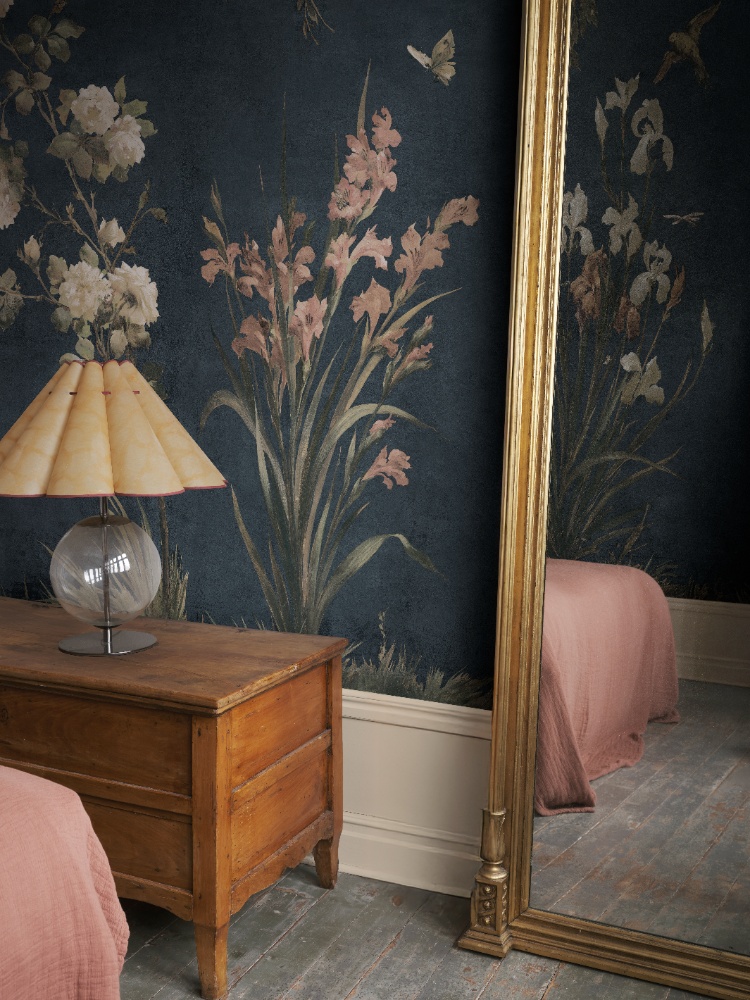
Featured: Nicola, Floral Mural Wallpaper
What to settle before you commit in a bedroom:
- Put the rail above the headboard, never behind it. Headboards run anywhere from about 1m to 1.4m tall, so measure the one you own before marking the wall. A rail that disappears behind a headboard wastes both the panelling and the paper.
- Leave the bed wall plain below if you want the mural whole. Panel the other three walls and run the paper floor to ceiling behind the bed. You still get the panelled room, and the mural keeps its full composition.
- Decide on plug and switch positions first. Bedside sockets and reading-light switches sit right at dado height. Fix their positions before the panels go on, and if you are considering wall-mounted lights, run the cable now rather than later.
Your bedroom should be a sanctuary, a space that reflects your personal style and helps you unwind at the end of the day. Explore our bedroom wallpaper designs to create your perfect retreat.
Wainscoting and Wallpaper for the Entryway
An entryway is often the first space people see as they enter your home, so it is worth making the best impression. Panels can help a narrow space look wider or taller than it is, while wallpaper above brings personality and a modern touch.

Featured: Belle Foliages Wallpaper
An entryway asks more of panelling than any other room, so a few things are worth getting right:
- Take it higher here than anywhere else. Around 1.2m is sensible, because this is the wall that takes bags, shoes, coats and pushchairs. The extra height costs very little and saves the paper above it.
- Use eggshell or satin on the panels, not matte. Hallway panelling gets wiped more than any surface in the house, and matte finishes mark where a washable sheen does not.
- Decide how the rail meets the stairs before you cut anything. Either follow the stair pitch or step the rail up in sections at the landings. Both work, but mixing the two in one hallway is what makes panelling look improvised.
If you are looking to give your entryway some love, explore our small entry design ideas and wallpapers to get inspired.
Wainscoting and Wallpaper for the Kid's Room
Panelling is a sensible move in a child's room, because it protects the wallpaper from being drawn on and takes the brunt of toys, scooters and bed frames. Wall panels are fuss-free to wipe down, and keeping the wallpaper above the rail makes it far easier to change as your child grows. Plan the panel height so the rail falls above the headboard rather than behind it.

Featured: Coral and Friends, Wallpaper

Featured: Lush Kingdom, Animal Mural Wallpaper

Featured: Bears and Bees, Animal Mural Wallpaper

Featured: Hand Drawn Plaids, Hello Circus x HouseofChais, Wallpaper
You do not need joinery to get this effect either. A plain painted lower wall with a crisp horizontal break does the same job visually, and a mural above it gives the room its character without any carpentry at all.

Featured: Monochrome Dino, Mural Wallpaper
A few things make the difference between panelling that lasts and panelling you redo in three years:
- Plan the rail height for the next bed, not the current one. A cot becomes a toddler bed becomes a single. Setting the rail at around 1m covers all three, where a rail set to a cot height will look wrong within two years.
- Specify a scrubbable finish on the panels. Eggshell or a dedicated washable emulsion will take crayon and sticky hands. The panelling is meant to be the sacrificial surface, so let it do that job and keep the paper above arm's reach.
- Keep the panelling neutral and let the paper date. Children's taste changes faster than joinery can keep up. Painting the panels a quiet colour means that when the dinosaurs have to go, you change one band of wallpaper rather than the whole room.
Choose your child's favourite design from our curated collection of kids wallpapers.
Wainscoting and Wallpaper for the Dining Room
Using wallpaper and wainscoting together in the dining room creates a warm, inviting space for family meals and entertaining. The combination is both stylish and functional. Wallpaper with a subtle pattern adds interest at eye level, while the panelling below takes the knocks from chair backs, which is the one thing that marks a dining room wall faster than anything else.

Featured: Elegant Rainforest, Wallpaper

Featured: Eden and Friends, Pattern Wallpaper
Dining rooms have one measurement that matters more than the rest:
- Set the rail just above chair-back height. Most dining chairs meet the wall somewhere between 850mm and 1m. Pull a chair up to the wall and mark where it touches, then put the rail above that line so the chair backs hit timber rather than paper.
- Let the panelling cover the radiator zone. Paper directly above a radiator can discolour over time with the rising heat. Where the radiator sits on a papered wall, running the panelling up past it is the simplest fix.
- Keep the pattern quiet if the room doubles as a workspace. Dining tables take laptops on weekdays. A tonal or small-scale design above the rail stays comfortable to sit in front of for hours, where a large-scale mural is better placed on the wall you face across the table rather than the one behind your screen.
Create a beautiful gathering space with our collection of dining room wallpapers. From traditional patterns and rich colours for formal settings to light, airy motifs for everyday gatherings, our designs are curated to suit a variety of styles.
Wainscoting and Wallpaper for the Kitchen
When choosing wallpaper and wainscoting for your kitchen, start with the height of your worktop. Running the panelling or tiling to just above the counter line keeps the wallpaper clear of splashes and gives the room a clean horizontal to work from. For a traditional look, opt for a floral or botanical design above. For something more modern, geometric shapes and bold colours hold their own against hard surfaces.

Featured: Anton Wallpaper

Featured: Laura Stripes Wallpaper
Cabinetry can take the place of panelling altogether. Where a run of shaker units already sets a strong horizontal, treat the wall above as a single band and let a deeper, more saturated design do the work.
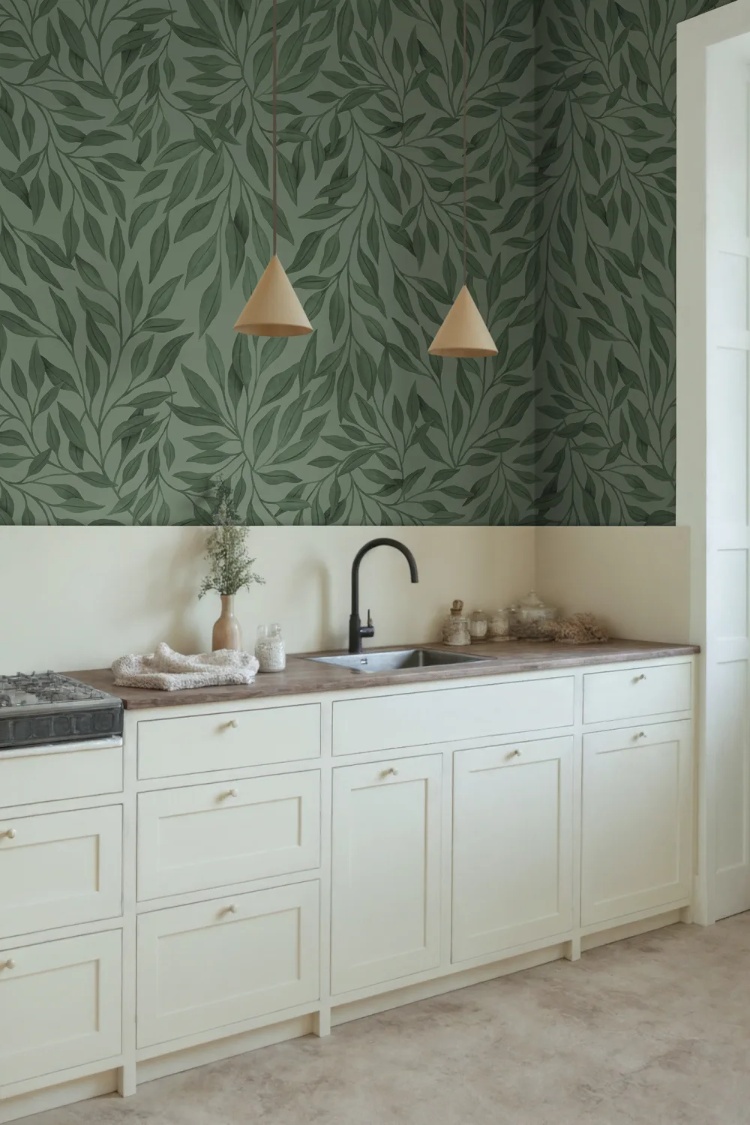
Featured: Willow, Botanical Pattern Wallpaper
Kitchens are the room where getting the detail right matters most:
- Tie the panelling height to the splashback, not to a rule of thumb. Finishing the tiling or panelling at the same line as your splashback gives the room one clean horizontal. Two different heights competing across one wall is what makes a kitchen look pieced together.
- Keep wallpaper out of the hob zone entirely. Behind and immediately beside the hob should be tile, glass or stainless steel. Start the paper on the next stretch of wall along, where heat and spitting oil will not reach it.
- Seal the top edge where tile meets paper. A cap rail or a neat bead of silicone along the top of the tiling stops water running down the tile face and wicking behind the wallpaper edge, which is the most common way kitchen paper starts lifting.
Whether you are designing a cosy breakfast nook, refreshing a dry kitchen or adding charm to your pantry, our kitchen wallpapers offer a balance of style and function.
Wainscoting and Wallpaper for the Bathroom
Wainscoting is a practical way to introduce wallpaper in a bathroom or powder room, because it keeps splashes off the paper and the paper itself well above the wettest part of the wall. Tiles are an excellent option for this, and here are some of our favourite pairings of wallpaper and tiling in bathrooms.

Featured: Cross Stitch (HelloCircus x HouseofChais), Wallpaper

Featured: Adora Vintage Flora Wallpaper

Featured: Classic Clematis Wallpaper

Featured: Classic Fish, Pattern Wallpaper
Wallpaper works well in a bathroom as long as you respect the wet zones:
- Tile to splash height on wet walls, and keep the paper to the dry side. Around the bath and shower, take the tiling to at least shower-head height. Paper belongs on the wall behind the basin, the WC or the towel rail, where it only ever meets steam.
- Ventilation matters more than the paper spec. An extractor that actually runs on, and a window opened after a shower, will do more to keep wallpaper on a bathroom wall than any material choice. In a room with neither, reconsider.
- Leave a painted gap between tile and paper. Finish the tile with a cap rail, then leave 30 to 50mm of painted wall before the wallpaper starts. That small band means water sitting on the tile edge never reaches the paper, and it gives you a clean line to cut to.
Explore more in our guide on modern bathroom wainscoting ideas with wallpaper inspiration.
How to Do Wainscoting
Installing wainscoting can be a satisfying DIY project or a professional job, depending on your skill level and the complexity of the design. Here is the sequence to follow:
- Measure your walls. Decide the height first, working to roughly one-third or two-thirds of the wall rather than the midpoint. Mark a level line all the way round before you cut anything.
- Choose your style. Pick a profile that suits the room and the wallpaper going above it, whether that is beadboard, board and batten, shaker or raised panel.
- Prepare the wall. Remove existing skirting or trim, fill any damage, and make sure the surface is clean, dry and flat. Panelling will telegraph a bowed wall.
- Cut and fit the panels. Measure and cut to size, dry-fitting each piece before you fix it so the joints line up cleanly at corners.
- Attach the wainscoting. Use grab adhesive with finishing nails into the studs for anything load-bearing on the rail.
- Add trim and moulding. Fit the top rail or chair rail last, and scribe it into any uneven corners rather than relying on filler.
- Fill, sand and paint. Fill the nail holes, caulk the joints, sand smooth, then prime and paint. Let the paint cure fully before you hang wallpaper against it.
One point on ordering: if the wallpaper is going above a rail, measure the papered height from the top of the panelling to the ceiling rather than from the floor. Ordering to full wall height is the most common way people end up with more paper than they need.
Should You Choose Mural or Patterned Wallpaper with Wainscoting?
Pairing wallpaper with wainscoting instantly adds depth and charm to a room, but choosing between a mural and a repeating pattern changes the atmosphere completely. Here is how to decide which suits your space.
Choose Mural Wallpaper If
- You want a focal point. Murals act like large-scale artwork. Paired with simple panelling they become the star, which works well behind a sofa or on a single feature wall.
- Your room has minimal furniture. In pared-back spaces, a mural above the panelling adds drama without crowding the design.
- You are after an artistic or contemporary mood. Landscape scenes, abstract washes and nature-inspired murals feel immersive and modern, and the structure of panelling below keeps them grounded.

Featured: Shoji, Japanese Mural Wallpaper
Create a room that tells a story with our collection of mural wallpapers.
Choose Patterned Wallpaper If
- You want a cohesive, continuous look. Patterns flow naturally around a room and work across multiple walls without pulling attention to any single area.
- You are layering with art, shelves or statement furniture. Subtle prints let other elements shine, acting as a backdrop rather than a centrepiece.
- You love a classic or cottage-inspired style. Think florals, stripes and hand-drawn motifs. These pair effortlessly with panelling for a look that is timeless and inviting.

Featured: Edvin Rhombus, Pattern Wallpaper
From classic and timeless prints to modern and whimsical ones, our pattern wallpaper collection offers a wide range of options for your walls.
How to Modernise Wainscoting
Panelling can add elegance to any room, but it can also look tired. Besides pairing it with wallpaper, here are a few ways to bring it up to date:
- Repaint it into the wall. Painting panelling and the wall above in the same colour, in a matte or eggshell finish, is the single quickest way to modernise it. Gloss white panels below a coloured wall is the combination that dates a room.
- Raise the rail. If the existing panelling stops low and the room has the height for it, extending the top rail to two-thirds of the wall transforms the proportions.
- Hang art against it. Leaning or hanging pieces that overlap the rail breaks the horizontal line and stops the panelling reading as a band around the room.
- Add a mirror. A large mirror set above the panelling bounces light back into the room and makes the upper wall feel more open.
- Simplify the moulding. Swapping an ornate cap rail for a slim square-edged one instantly makes older panelling feel less formal.
Planning Your Own Wainscoting and Wallpaper
Most of the decisions in this guide come down to two numbers: how high the rail sits, and what goes above it. Get the height right for the room and the furniture in it, keep the panel colour tied to your skirtings and door frames, and the wallpaper above has an easy job.
If you are starting in a wet room, our guide to modern bathroom wainscoting ideas with wallpaper inspiration goes deeper on tiling and placement. For choosing the wall itself in a bedroom, see our guide to bedroom feature wall ideas.
Browse the full range of wallpaper designs and order a sample so you can hold it against your panel colour, in your own light, before you commit.
Transform Your Home with Made-to-Measure Wallpaper
Explore our full collection of wallpaper designs and get inspired to find the perfect design for your home. Installation services are available in selected countries, so just add it at checkout if it’s offered in your area.
At Hello Circus, we believe every wall deserves something special. That’s why all our wallpapers are custom-made to fit your wall’s exact dimensions, with no generic rolls and a perfect fit every time. Priced by the square metre (Height × Width × Unit Price), you only pay for what you need.
Choose the Right Wallpaper Material
Whether you’re decorating your forever home, updating a rental property, or refreshing a single feature wall, choosing the right wallpaper material can make all the difference. At Hello Circus, every wallpaper design is available in three premium materials, so you can select the option that best suits your space, installation preferences, and lifestyle.
- Non-Woven Matte Wallpaper: Our most popular choice, featuring a smooth, non-reflective finish that creates a beautifully soft look. Durable, breathable, and easy to install using the paste-the-wall method, it’s ideal for most residential interiors.
- Heavy Duty Textured Vinyl Wallpaper: Designed for busy households and commercial spaces, this premium textured finish offers added durability and a luxurious tactile feel. It’s perfect for high-traffic areas where extra resilience is required.
- Peel and Stick Wallpaper: A self-adhesive option that makes decorating quick and convenient. Ideal for renters, DIY enthusiasts, or anyone who prefers a paste-free installation, peel and stick wallpaper allows you to refresh your walls with minimal fuss while enjoying the same beautiful Hello Circus designs.
Whichever material you choose, every wallpaper is custom-made to your wall’s exact dimensions using high-quality printing and vibrant, colour-rich inks, ensuring a beautiful finish that’s made to last.
Curious About the Cost? Try Our Wallpaper Visualiser
- Enter your wall’s width and height for an instant price.
- Preview how your chosen wallpaper will look on your wall, which is especially helpful for murals, where placement matters.
Still deciding? Order a sample to feel the texture, quality, and finish before you commit.
How to Calculate How Much Wallpaper You Need?
Before purchasing, it’s important to measure your wall accurately to avoid over- or under-ordering. Here’s a simple way to get started:
- Measure the width of the wall from edge to edge.
- Measure the height from floor to ceiling.
- Allow for extra, around 10cm, to account for trimming and pattern matching.
Need help? Read our guide on how to measure your wall for wallpaper or get in touch with us.



