
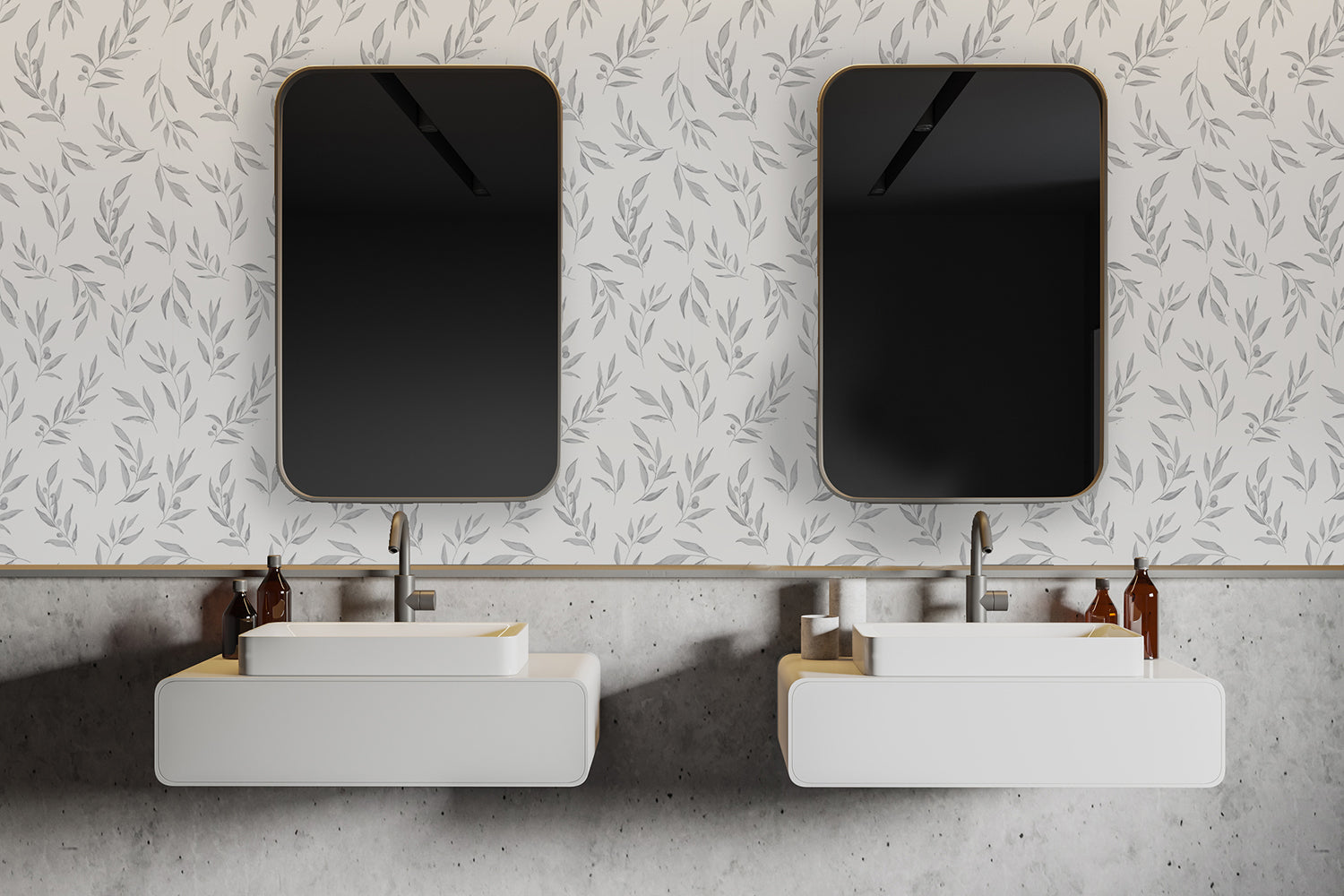
Most people assume there is not much you can do with an HDB toilet. It is small, it is mostly tiled, and a good deal of it is fixed in place. Look at what is left once the tiling stops, though, and there is more to work with than you would think: the wall behind the door, the stretch above the basin, the run above the tiles. Whether you are drawn to coastal patterns, a botanical mural, something bold and graphic or a soft plaster texture, those few square metres are enough to turn the most functional room in the flat into the one that surprises people. Because the room is small, one good decision changes the whole of it.
In this guide, we’ll start with what HDB actually lets you change and when, then work through laying the room out around the wet zone, the fixtures and the storage. After that we’ll look at where wallpaper works in a toilet and which walls can take it, compare light and dark schemes, and share our favourite designs for a dry toilet wall, along with the practical details that decide how long the finish lasts.
What Can You Actually Change In An HDB Toilet?
Everything you might want to change in an HDB toilet falls into one of three groups: work you can do freely, work that needs a renovation permit, and work you cannot do at all until the block is three years old. Working out which group your plan sits in, before you call a contractor, saves the most expensive kind of rethink.
HDB sets these rules out in its renovation guidelines for building works, and they are tighter for bathrooms and toilets than for any other room in the flat. Waterproofing is the reason. The membrane beneath your floor protects the unit below yours, so HDB controls anything that disturbs it.
What The First 3 Years Restrict
Newly built flats have a three-year restriction period on the removal of wall and floor finishes in bathrooms and toilets, counted from the date the block was completed. The tiles your flat came with stay where they are for those three years, whatever you make of them.
This is the rule that catches BTO owners, because it bites exactly when you are keenest to renovate. Read HDB’s wording closely, though. What the restriction covers is the removal of the existing finishes. Laying something new on top of them is treated as a separate kind of work, and that route is open from the day you collect your keys.
Which Toilet Works Need A Renovation Permit
Replacing the wall or floor finishes in an HDB toilet needs a permit, and so does enlarging the toilet or replacing its vent. Your contractor normally applies on your behalf, but the permit is issued to you as the flat owner, so it pays to know what has been applied for.
Each permitted job carries limits. Floor finishes and screed together must not exceed 50mm, and wall finishes including plaster must not exceed 25mm. Pre-packed waterproofing screed and a waterproofing membrane go down before any new floor finish, and the membrane has to be upturned at least 150mm against the walls, kerbs and pipes. Floor traps take a UPVC grating with a long collar.
Enlarging the toilet becomes possible after the first three years, but only just. The extension cannot be more than 600mm wide or 0.6 square metres in area, and HDB specifies that it can only be used as a dry area, for a wash basin or shelves rather than anything that gets wet.
Overlay Or Hack?
Laying new finishes over the existing ones with adhesive needs no permit, which makes overlay the practical route for a toilet you are not allowed to hack yet. Thickness is the trade-off. Wall finishes laid this way must not exceed 13mm, floor finishes must not exceed 13mm including the adhesive, and only one existing layer may sit underneath, so you get one overlay and no more.
HDB also requires that the work does not cause backflow or lateral seepage into the bedroom, and the floor trap must not be tampered with. Both are worth repeating back to your contractor, because they describe exactly how a cheap overlay fails.
Hacking gives you a bare substrate and a fresh waterproofing layer, which is the better long-term answer in an older flat. It also costs more, needs a permit, and takes the toilet out of use for longer. We’d point most BTO owners towards overlay and most resale owners towards hacking, on the straightforward grounds that a new flat’s membrane is new and an older flat’s has been working for decades.
How Do You Plan The Layout Of A Small HDB Toilet?
An HDB toilet works best when the shower, the WC and the basin each get their own zone and the wet one is kept at one end of the room. Floor area is fixed and the fittings sit largely where the pipes put them, so planning here is less about moving things than about deciding what the floor has to stay clear for.
Separating The Wet Zone From The Dry Zone
A physical break between the shower and the rest of the room is the single most useful change you can make in an HDB toilet, because it decides where water goes and therefore what the walls can carry. A cement mortar kerb up to 100mm high and 100mm wide needs no permit, and a clear glass screen sitting on it contains the spray without closing the room in visually.
Where a screen will not fit, hang the curtain from a ceiling-mounted track rather than a wall-mounted rail, since a track can be run closer to the kerb line. Fall matters as much as the barrier does. If the floor slopes towards the trap, a kerb holds water back; if it does not, nothing you put there will.
Fixtures That Buy Back Floor Space
Wall-hung and floating fixtures earn their extra installation cost in a toilet this size, because they give back the floor, and visible floor is what stops a small room reading as cramped. A wall-hung WC, a floating vanity and a corner basin each free up a strip of tile you can actually see.
Check two things before committing. A wall-hung WC needs a concealed cistern, which adds depth behind the pan, so measure it against your narrowest wall rather than assuming it fits. And anything wall-hung needs proper structural backing, which is a question for your contractor and not a weekend job.
Where The Storage Actually Goes
Storage in an HDB toilet usually has to come off the walls, because there is no spare floor and the one place with real depth is above the WC cistern. A shallow cabinet there, a mirror cabinet over the basin and a recessed niche in the shower between them hold almost everything a household keeps in this room.
Leave the niche out of your plans if the block is under three years old, since forming one means removing wall finishes. A surface-mounted corner shelf does the same job in the meantime, and the vent wall is usually the one wall with nothing else competing for it.
Common Toilet Versus Master Toilet
The two toilets in an HDB flat want different plans, because the common toilet takes guests and the master toilet takes the morning rush. The common one is usually the smaller and the one visitors see, which makes it the better place to spend on how the room looks rather than on what is fitted in it.
Drying time is the master toilet’s real constraint, since it gets used twice a day by the same people and rarely has a chance to air out in between. If the budget only stretches to one glass screen, we’d put it in the master toilet and treat the common toilet as the room where a decorative wall earns its keep.
Can You Put Wallpaper In An HDB Toilet?
Wallpaper belongs on the dry walls of an HDB toilet and nowhere near the shower. In a flat where showering happens in the same open room as everything else, that rules out a good share of the wall area, and being straight about it is the difference between a wall that still looks right in two years and one that lifts at the seams inside twelve months.
That is the honest answer, and it is worth giving because the rest of the results you are reading will not give it. The useful question is not whether wallpaper survives a bathroom in general. It is which walls in your toilet stay dry, which comes down to where the shower sits and how quickly the room clears its own steam.
Where Wallpaper Works, And Where It Will Not
Leave the shower enclosure alone, leave the splash zone around the basin alone, and in a toilet with no screen or curtain, leave anything within reach of the spray alone as well. Standing water, repeated wetting and the scrubbing that follows will defeat any wall covering, and in a wet room with no barrier that accounts for most of the room.
The walls worth papering are the one behind the door, the stretch above the WC where no basin sits alongside it, the run above a tiled dado on the dry side of a kerb, and the mirror wall where the basin already has a splashback. HDB’s own term for this part of the room is the dry area, the phrase it uses in the rule capping a toilet extension at 600mm for dry-area use, so the distinction is one HDB draws too.
Material helps on a dry wall, though it does not change where one can go. Of our three materials, the heavy duty textured vinyl is the one we recommend for high-moisture rooms, because it is more resistant to moisture than the others and is treated with an anti-microbial biocide. None of the three is waterproof, so the zoning above still decides where the paper goes rather than the specification does. We compare all three for a toilet in the common questions further down.
Does Wallpaper Need An HDB Permit?
No. HDB lists wallpaper among the wall finishes that need no renovation permit, alongside cement and sand plastering, gypsum plastering, rock-stone finish and spray painting. It is one of the few changes you can make to an HDB toilet without an application of any kind.
The three-year restriction does not stand in your way either, because papering adds a finish rather than removing one. That combination matters more than it sounds. A BTO owner who cannot touch the tiles until the block turns three can still change how the dry walls look, and anyone weighing up a full hack later can live with a colour on one wall first and find out whether they still like it.
Why Ventilation Decides It
Ventilation decides whether wallpaper lasts in an HDB toilet, more than the paper or the adhesive does. A toilet that clears its steam in a few minutes gives a papered wall a fair chance. One where the mirror stays fogged for half an hour does not, whatever you hang on the walls.
Three things are worth checking before you commit. Whether the toilet has a window or only a mechanical vent, how long the fan keeps running once you switch the light off, and whether the door has a gap at the bottom to let air replace what the fan pulls out. We’d run the fan for fifteen to twenty minutes after a shower rather than killing it with the light, which does more for a papered wall than any other single habit.
What Are The Best HDB Toilet Wallpaper Styles?
Six styles do most of the work in a compact toilet: coastal and shell motifs, botanical murals, bold graphics, dark designs, large-scale florals, and plaster-effect textures. Which one suits you depends less on taste than on how much wall you have left once the tiling stops, and on whether the room has a window or runs on a ceiling light alone.
Coastal And Shell Patterns
Coastal patterns put small, scattered motifs on a pale ground, and they suit a toilet because they give the eye somewhere to go without crowding a room you can cross in two steps. Shells, pebbles and simple marine shapes read as texture from the doorway, which keeps a narrow space calm, and they resolve into something more detailed when you are standing at the basin. Pale sand and nude grounds are the practical choice in a toilet with no window, since they bounce what little light there is rather than absorbing it. Keep the motif small if the papered wall is broken up by a mirror, a cabinet or a vent, because a large repeat looks accidental once it has been cut around three fixtures.
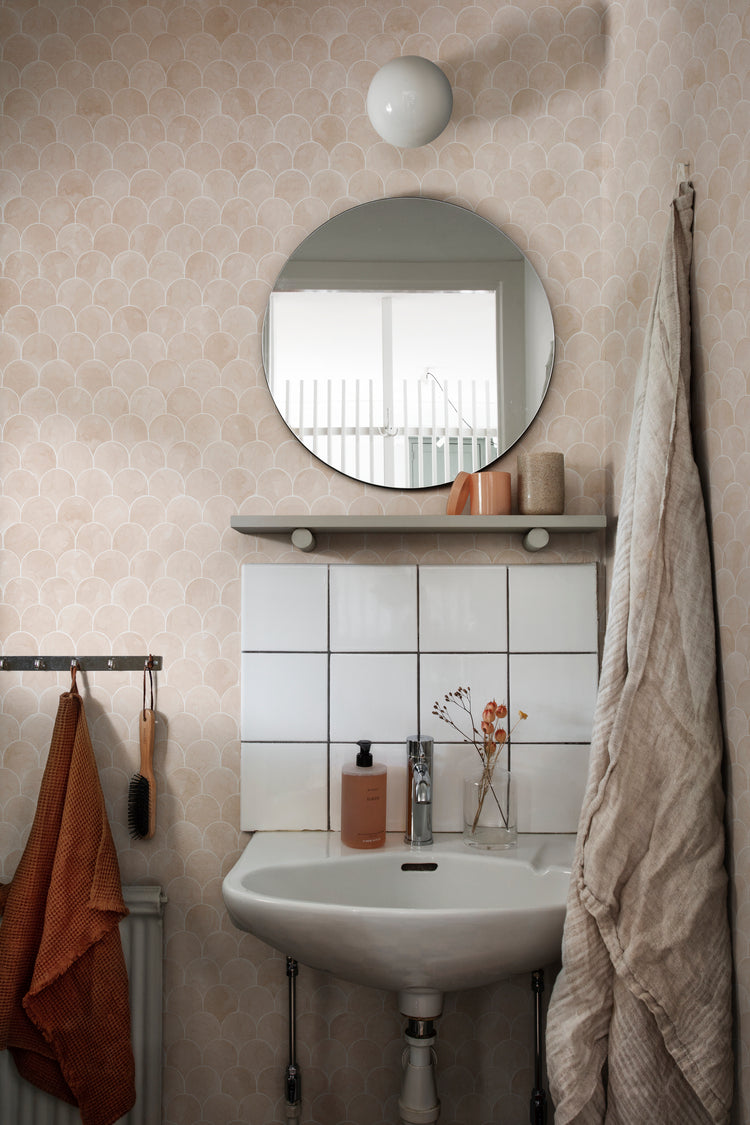
Featured: Igor Shells, Pattern Wallpaper
Botanical Murals
A botanical mural is one continuous painted scene rather than a repeating tile, which is what makes it work on the short wall of a small toilet. Because the image never restarts, the eye travels across it instead of measuring the room, and a wall that is genuinely only a metre or so wide stops announcing its width. Soft greens, greys and chalky neutrals suit a room full of white sanitaryware, and they hold their colour under the cool bulbs most toilets are fitted with. The one thing to plan is where the mural sits vertically, since a scene designed to run floor to ceiling loses its composition when the bottom third disappears behind tiling.
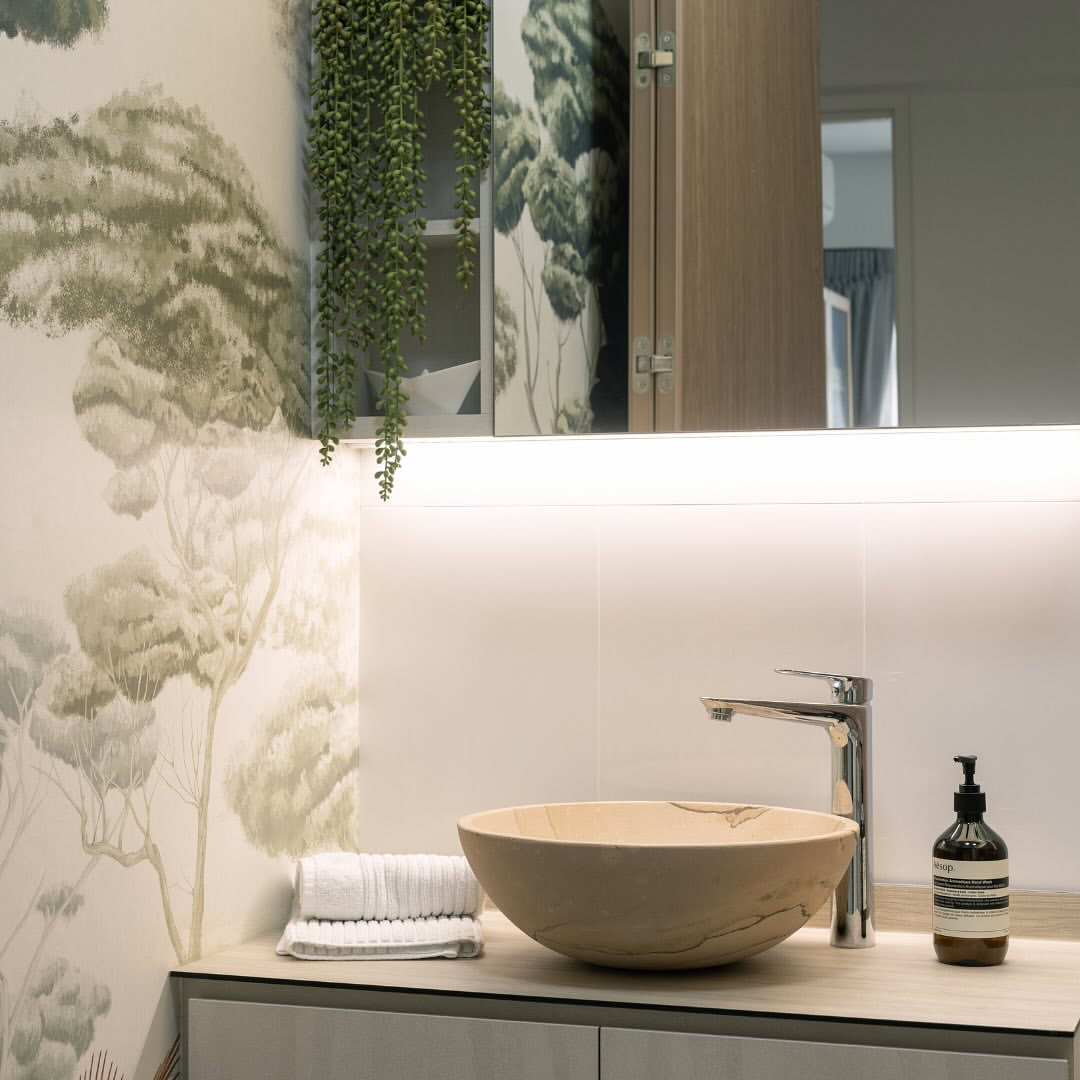
Featured: Garden Eden, Tropical Mural Wallpaper
Browse the full range of leaf, vine and plant designs in our botanical wallpaper collection.
Bold Graphic Patterns
Bold graphics are the one style a toilet carries better than the rooms you actually spend time in. Large shapes in two high-contrast colours would dominate a bedroom you sleep in, but in a room you are in for four minutes they register as confidence rather than noise. High contrast also survives the flat overhead lighting most toilets have, where subtler patterns tend to flatten out and disappear. The usual advice about scale runs backwards here: a big motif on one short wall makes the room feel intentional, while a small busy repeat across every surface makes it feel smaller. Pair it with plain tiling and plain sanitaryware so the pattern is the only thing competing for attention.
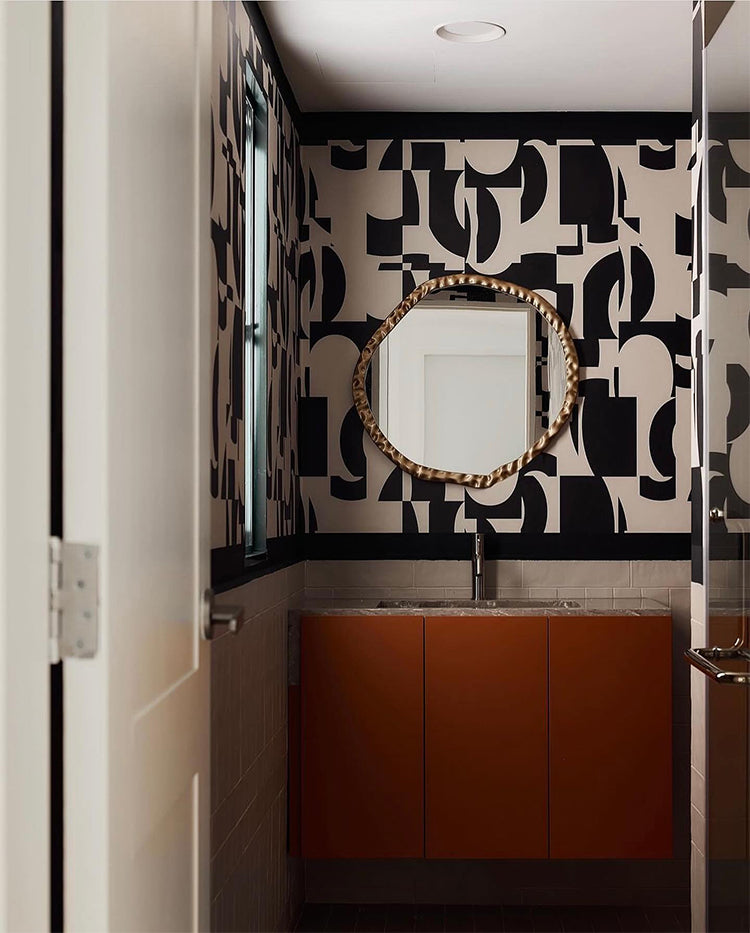
Featured: Slow Assembly, Geometric Pattern Wallpaper
See the full range of shapes and repeats in our geometric wallpaper collection.
Large-Scale Florals
Large florals belong above a tiled dado, where the tiling gives them a clean horizontal line to start from and takes up the lower half of the wall they would otherwise overwhelm. Blooms at a generous scale turn the upper wall into a single composition rather than a pattern you read as a grid, and in a room this small that is the difference between dramatic and busy. Blush, cream and soft green grounds keep the effect gentle and pick up warmth from almost any bulb, which flatters a room most people only see first thing in the morning. If the wall is full height with no tiling at all, drop to a smaller repeat instead, since a large floral needs the dado to look deliberate.
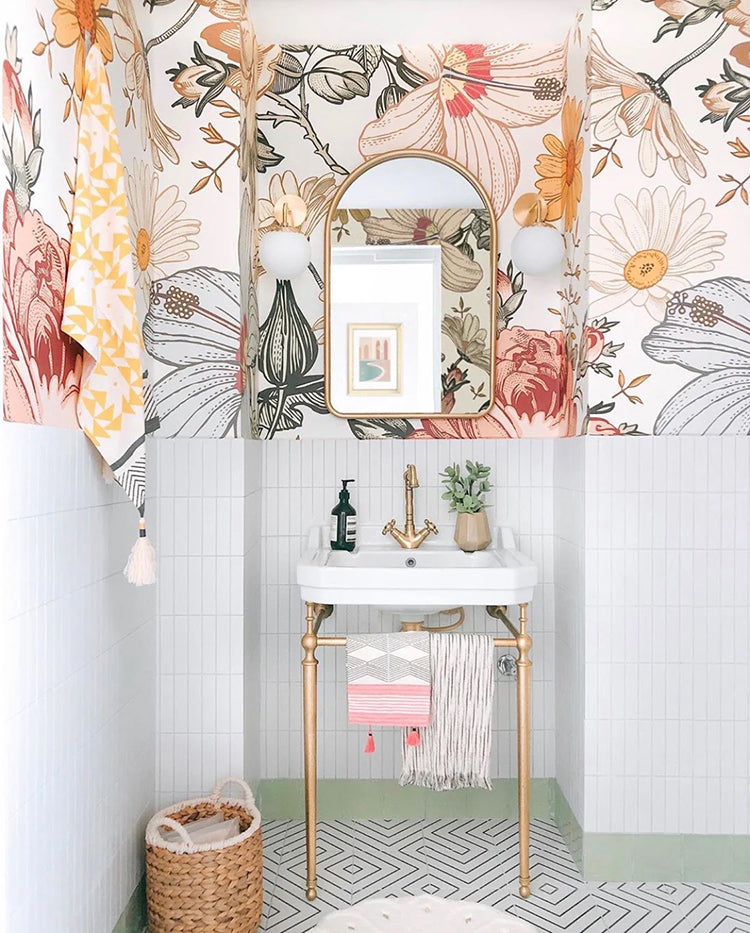
Featured: Adora, Vintage Floral Pattern Wallpaper
Browse every bloom and botanical print in our floral wallpaper collection.
Plaster And Texture Effects
Texture is the quiet option, and in a toilet it solves a problem pattern cannot. Every surface in this room is hard and reflective, from the tiling to the mirror to the sanitaryware, and a plaster, concrete or washed-pigment effect puts one soft, irregular surface back into the mix. Because the design barely repeats, it suits an awkward wall better than a motif does, and it can be cut around a vent, a cabinet or a boxed-in pipe without anything looking interrupted. Warm beiges and greys sit comfortably with brass, timber and matt black fittings, none of which they compete with. Choose this when you want the room to feel calm rather than decorated.
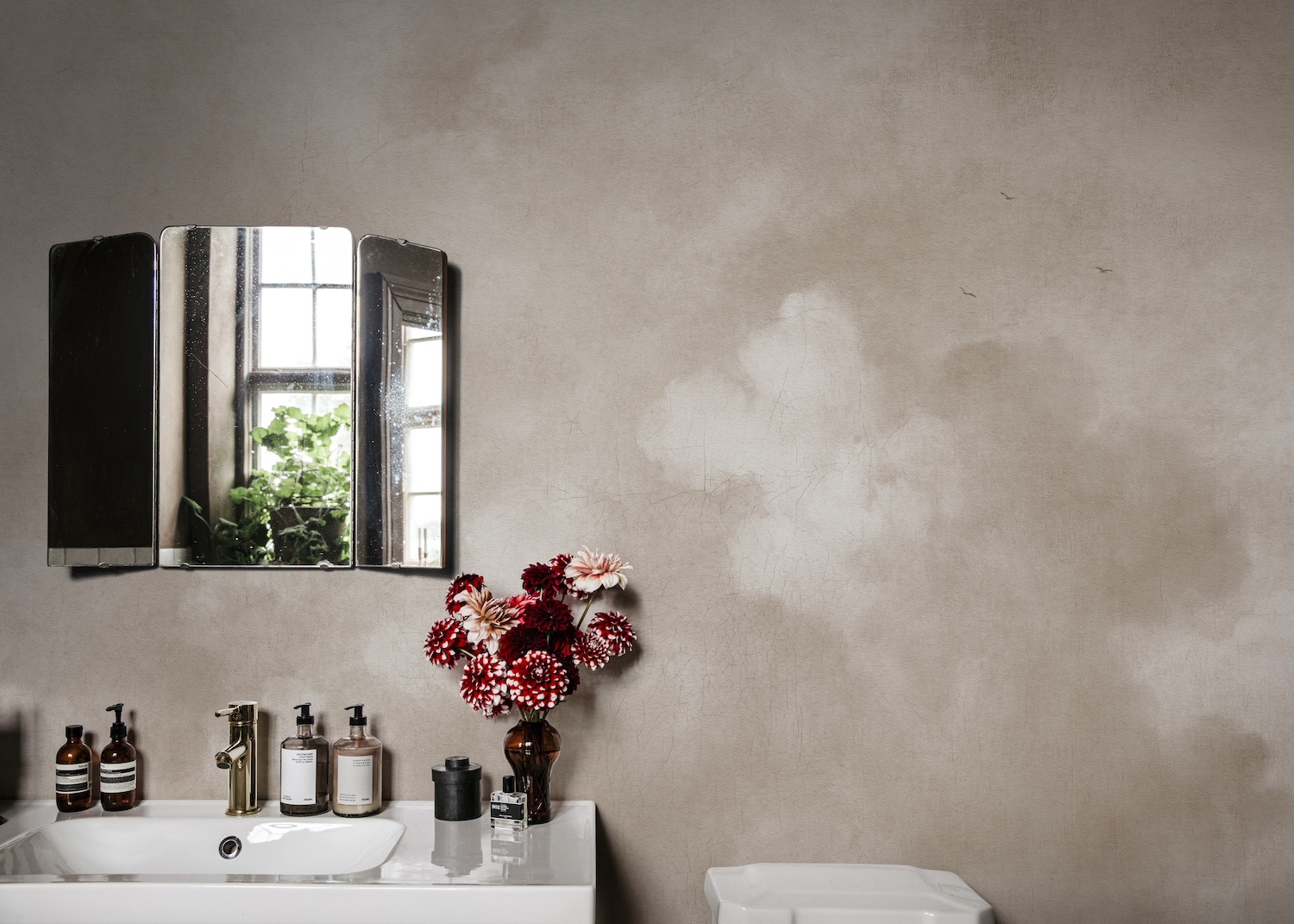
Featured: Vintage Clouds, Mural Wallpaper
Explore every plaster, concrete and fabric-effect design in our textured wallpaper collection.
Should An HDB Toilet Be Light Or Dark?
Light is the safer choice in a toilet lit by a single ceiling fitting, and dark is the better one wherever you can get warm light down at eye level. The decision turns on what the room has to work with rather than on what looks good in a photograph, and in most HDB flats that comes down to three things: how much daylight the room gets on its own, what is actually fitted for light, and how much of the wall the tiling has already claimed.
When A Light Scheme Works Better
Go light when the only light source is overhead. A pale ground reflects what little comes off a single ceiling fitting and spreads it around a room that has no other help, which is the situation in most windowless common toilets. Light schemes also sit more comfortably with the pale floor and wall tiles HDB flats tend to come with, so you are working with the existing finishes rather than against them, which matters when the tiling is staying put for three years. The trade-off is that a pale wall shows you precisely where the corners are, and in a very small toilet it can read as clinical. Texture rather than pattern is the usual fix, since it gives a light wall somewhere to catch a shadow.
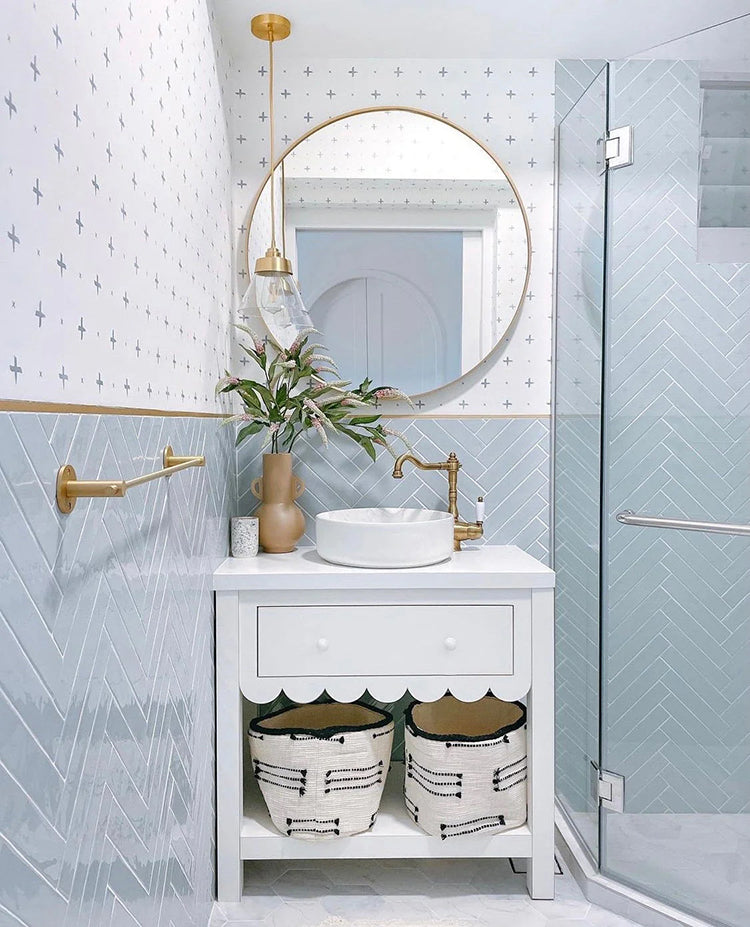
Featured: Cross Stitch, Blue Pattern Wallpaper
When A Dark Scheme Works Better
Go dark when you can add light at the mirror. A lit mirror, a warm bulb or a wall fitting beside the basin is what makes a dark toilet feel intimate instead of gloomy, and without one a dark wall under a single cool ceiling light will simply look like an unlit room. Given that light, dark pays off most in a toilet nobody lingers in, which usually means the common one guests see rather than the master toilet you stand in every morning getting ready. A windowless toilet is a better candidate than one with a window, since a dark wall beside bright daylight tends to look like a mistake at noon and nothing like the photograph that sold you on it.
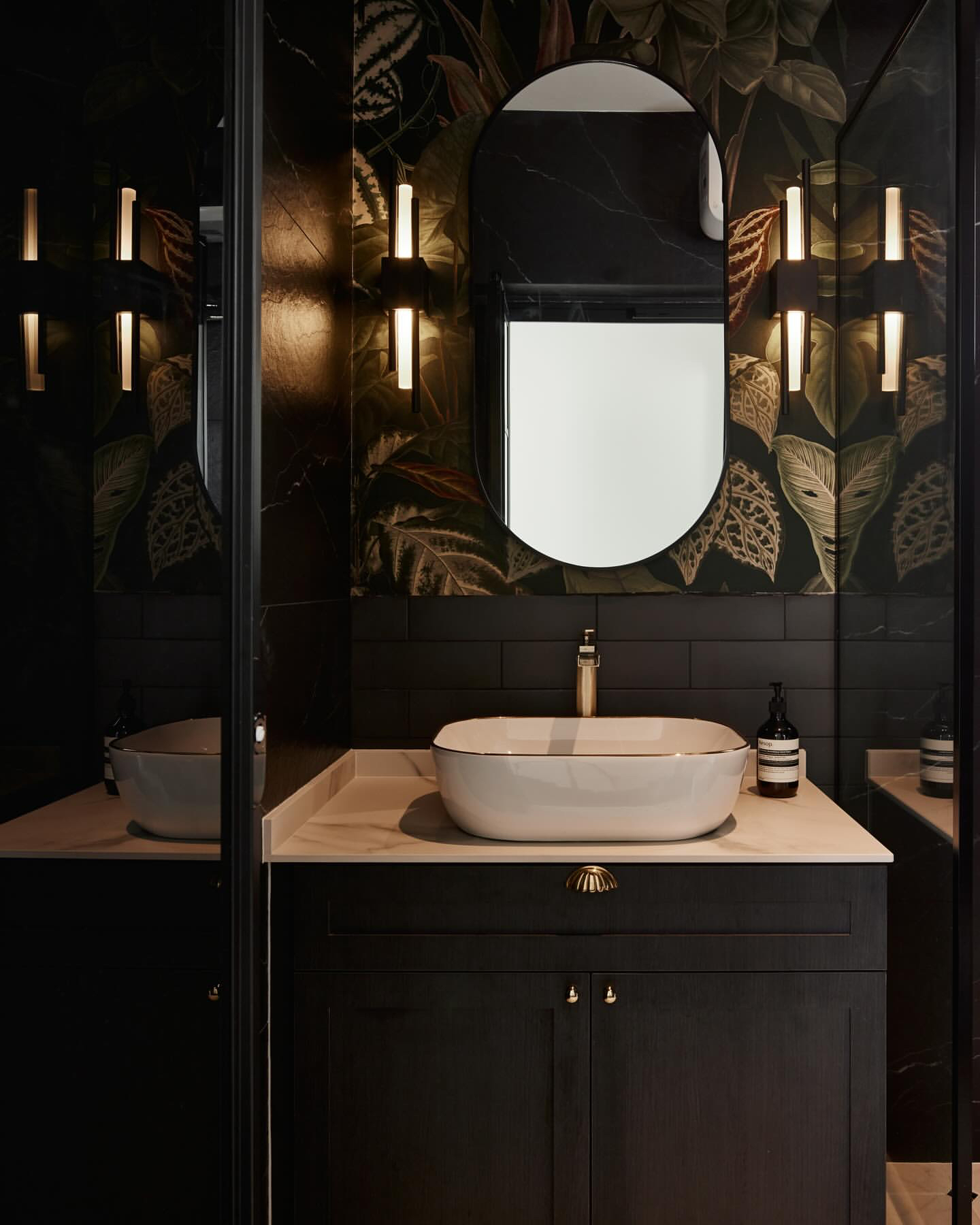
Featured: Night-time Jungle, Tropical Mural Wallpaper
For more on making dark colours work, read our dark and moody wallpaper guide.
Splitting The Difference
Most HDB toilets end up somewhere between the two, and that is usually the right answer. Because the tiling has already claimed everything below waist height, a dark paper above a pale dado gives you depth at eye level while the light tiling keeps the floor area feeling open, and the horizontal line between them makes a narrow room look wider rather than taller. The reverse works too. A pale paper with dark fittings, a black framed mirror or a deep painted door delivers contrast without committing the whole room to it, and it is far easier to undo in three years when the tiles finally come out.
How Do You Finish And Look After A Wallpapered Toilet Wall?
The difference between a wallpapered toilet wall that lasts and one that does not usually comes down to the edges and the order of work rather than the paper itself. Four things are worth getting right.
Finish The Edge Where Paper Meets Tile
The join between the bottom of the paper and the top of the tiling is where a toilet wall fails first, because it is the lowest point the paper reaches and the one most likely to catch splashes. Ask for the paper to stop slightly above the tile edge rather than running down to meet it, and seal the gap with a thin bead of clear or colour-matched sealant. A trim or a slim timber bead does the same job and gives the join a deliberate line, which also hides any wobble in the tiling underneath.
Plan Fixings Before The Paper Goes Up
Decide where the towel rail, hooks and mirror cabinet are going before the first drop is hung, because every one of them puts a hole through a finished surface. Mark the positions on the bare wall, hang the paper, then fix through it, rather than moving a rail afterwards and leaving a patch you cannot disguise. Where a fixing has to go into a wet or frequently splashed spot, keep it on the tiling instead and leave the papered wall for the things that stay dry.
Paper Last, After Every Wet Trade
Wallpaper is the final finish in a toilet, after the tiling, the waterproofing, the plumbing and the grouting have all been signed off. Hanging it earlier means a wet trade coming back over a finished wall, and it also means hanging paper onto a wall that has not had time to dry out. Give new plaster or new screed as long as your contractor recommends before anything goes on top, and keep the paper out of the programme until the room is otherwise finished.
Check The Door Swing Before You Choose The Wall
The wall behind the door is often the best candidate for wallpaper and the easiest one to get wrong. Open the door fully and see what it actually covers, since in a compact toilet a door at full swing can hide most of the wall it opens against, which wastes a mural and leaves you looking at a handle. Check too that the hinge side is not where you planned to put the most detailed part of a design, because that is the strip that disappears whenever somebody is in the room.
Common Questions About HDB Toilet Design
How Big Is An HDB Toilet?
HDB does not publish a room-by-room dimension for toilets. Its sales brochures give the floor area of the whole flat and supply the layout as a scale floor plan, so the only reliable way to get your own toilet’s measurements is to read them off that plan or measure the room yourself. Treat the specific figures quoted on renovation and furniture blogs with some caution, since they are typical examples rather than anything HDB states.
Can You Wallpaper Straight Over Toilet Tiles?
Wallpaper needs a flat, sound surface, so tiling with pronounced grout lines will usually show through rather than disappear. Where the tiles are flat and the grout lines are fine, a lining or a skim coat can even the surface out first. On a heavily textured or deeply grouted wall it is better to choose a different wall than to fight the substrate, and in a flat under three years old this matters more than usual, because taking the tiles off is not an option yet.
Which Wallpaper Material Should You Choose For A Toilet?
Choose the heavy duty textured vinyl. It is the only one of our three materials we recommend for high-moisture conditions such as restrooms, it is more resistant to moisture than the others, and it is treated with an anti-microbial biocide. It is also the heaviest and thickest of the three, with a linen emboss finish and good scrub resistance, and most of our designs can be produced in it on request.
The other two still have their place. Our standard non-woven matte carries a protective varnish for extra washability and scrub resistance, which copes with the occasional splash on a basin wall well away from the shower, and it is the material our Singapore installers prefer to work with. Peel and stick is wipeable and comes down cleanly, which makes it the sensible pick in a rented flat or anywhere you want to change your mind later. Read more about our wallpaper materials before you decide.
How Long Will Wallpaper Last In A Toilet?
On a genuinely dry wall in a room that clears its steam, wallpaper lasts as long as it would anywhere else in the flat. What shortens its life is not time but exposure, so a paper within reach of the shower or above a basin with no splashback will show its age in months rather than years. The honest answer is that placement and ventilation decide this, not the product, which is why both are worth more attention than the design itself.
Choosing The Perfect HDB Toilet Wallpaper For Your Home
The best wallpaper for an HDB toilet is one that suits your taste and respects where the water goes, and those two things are easier to reconcile than they sound. Whether you lean towards scattered shells, a painted botanical scene, a bold graphic repeat, large soft florals or a quiet plaster texture, a dry wall treated well can turn the most functional room in the flat into one of the most memorable rooms in your home. Pair it with a warm bulb at the mirror and a fan you actually run on, and the room will look and feel the way you intended for far longer.
Ready to start your project? Explore our full collection of bathroom wallpaper to find made-to-measure designs that suit HDB toilets, BTO bathrooms and powder rooms of every size, and order a sample first if you want to see how a colour behaves under your own lighting before you commit.
Transform Your Home with Made-to-Measure Wallpaper
Explore our full collection of wallpaper designs and get inspired to find the perfect design for your home. Installation services are available in selected countries, so just add it at checkout if it’s offered in your area.
At Hello Circus, we believe every wall deserves something special. That’s why all our wallpapers are custom-made to fit your wall’s exact dimensions, with no generic rolls and no wastage. Priced by the square metre (Height × Width × Unit Price), you only pay for what you need.
Choose the Right Wallpaper Material
Whether you’re decorating your forever home, updating a rental property, or refreshing a single feature wall, choosing the right wallpaper material can make all the difference. At Hello Circus, every wallpaper design is available in three premium materials, so you can select the option that best suits your space, installation preferences, and lifestyle.
- Non-Woven Matte Wallpaper: Our most popular choice, featuring a smooth, non-reflective finish that creates a beautifully soft look. Durable, breathable, and easy to install using the paste-the-wall method, it’s ideal for most residential interiors.
- Heavy Duty Textured Vinyl Wallpaper: Designed for busy households and commercial spaces, this premium textured finish offers added durability and a luxurious tactile feel. It’s perfect for high-traffic areas where extra resilience is required.
- Peel and Stick Wallpaper: A self-adhesive option that makes decorating quick and convenient. Ideal for renters, DIY enthusiasts, or anyone who prefers a paste-free installation, peel and stick wallpaper allows you to refresh your walls with minimal fuss while enjoying the same beautiful Hello Circus designs.
Whichever material you choose, every wallpaper is custom-made to your wall’s exact dimensions using high-quality printing and vibrant, colour-rich inks, ensuring a beautiful finish that’s made to last.
Curious About the Cost? Try Our Wallpaper Visualiser
- Enter your wall’s width and height for an instant price.
- Preview how your chosen wallpaper will look on your wall, which is especially helpful for murals, where placement matters.
Still deciding? Order a sample to feel the texture, quality, and finish before you commit.
How to Calculate How Much Wallpaper You Need?
Before purchasing, it’s important to measure your wall accurately to avoid over- or under-ordering. Here’s a simple way to get started:
- Measure the width of the wall from edge to edge.
- Measure the height from floor to ceiling.
- Allow for extra, around 10cm, to account for trimming and pattern matching.
Need help? Read our guide on how to measure your wall for wallpaper or get in touch with us.
Why Choose Hello Circus Wallpaper?
What makes our wallpapers different? Every Hello Circus wallpaper is made to order using premium materials designed to deliver exceptional quality, durability, and beautiful colour reproduction.
- Premium quality: Printed in Europe on durable non-woven paper, our wallpapers are reinforced with nylon fibres to stay smooth, strong, and long-lasting.
- Matte and non-reflective: Our non-woven wallpapers are coated with a soft, non-reflective matte finish that brings warmth and elegance to your space without harsh glare.
- Safe and non-toxic: We use VOC-free inks and PVC-free, breathable paper, so you can create a beautiful home without worrying about harmful chemicals, which matters most with little ones in the house.
- Antimicrobial protection: Helps prevent the growth of mould, mildew, and bacteria, keeping your walls cleaner and fresher for longer.
- Wallpaper washability: All our wallpapers are washable, meaning everyday dirt and water stains can be wiped away using a damp cloth or sponge.
- Resistant to colour fading: Designed with colourfast technology to keep your wallpaper vibrant and rich over time.
- Fire resilient: Our wallpapers meet European fire safety standards (EN ISO 11925-2), providing an extra layer of reassurance for your home.
Read more about our wallpaper materials and check out our ultimate guide to wallpapers for answers to the most commonly asked questions.
Let’s Connect
Have a project in mind or interested in partnering with us? We’d love to hear from you.
- Bulk orders
- Corporate orders
- Selling with us
- Collaborations
- Press features
Feel free to get in touch.



