

You have found the design, measured the wall twice and you are almost ready to order. Then the practical question lands: who is actually going to put it up? Hanging wallpaper is one of those jobs that looks simple on video and feels very different when you are halfway up a ladder with a damp, three-metre length of paper in both hands and a pattern that has to line up.
That is why we work with professional wallpaper installers here in Singapore. Below you will find what a wallpaper installer costs by wall size, what the fee covers, how to get your wall ready, and how long the whole thing takes. If you would rather do it yourself, we have covered that too.
How Much Does Wallpaper Installation Cost in Singapore?
Wallpaper installation with Hello Circus starts at S$215 for a wall under 6m² and is charged as a flat fee by wall area, so you know the full cost before you check out. These are our current rates in Singapore:
| Wall area | Installation fee (SGD) |
|---|---|
| Under 6m² | $215 |
| 6 to 9m² | $265 |
| 9 to 12m² | $315 |
| 12 to 15m² | $365 |
| 15 to 20m² | $450 |
| 20 to 25m² | $525 |
| 25 to 30m² | $600 |
| 30 to 35m² | $700 |
| 35 to 40m² | $775 |
| 40 to 45m² | $850 |
| 45 to 50m² | $950 |
| 50 to 55m² | $1,025 |
| 55 to 60m² | $1,100 |
Walls larger than 60m², and jobs that need extra preparation or awkward access, are quoted individually. Get in touch with your measurements and images of your room walls and we will come back with a quotation.
What That Works Out To
Standard HDB ceiling height is about 2.6m, so a typical bedroom feature wall of 3m wide by 2.6m high is 7.8m². That falls into the 6 to 9m² band, which is $265. A wider living room feature wall of 4m by 2.6m comes to 10.4m², landing in the 9 to 12m² band at $315.
Because the fee is tiered rather than purely per square metre, bigger walls cost less per square metre than small ones. A wall under 6m² works out to around $36 per m², while a 60m² job is closer to $18 per m². If you are weighing up doing one wall or the whole room, it is worth pricing both bands before you decide.
Installation is priced separately from the wallpaper itself. For what the paper costs by material and by wall, read our guide to wallpaper prices in Singapore.
What the Installation Fee Covers
Our installation fee is all-in for a standard wall, so there is no separate call-out charge or delivery fee to add on afterwards. It covers:
- Free delivery of your wallpaper within Singapore. Local shipping is included, so the price you see at checkout is the price you pay.
- Professional hanging by our partner installers, including trimming at the ceiling, skirting and around sockets and switches.
- Pattern matching across every drop, which matters most on murals and on tight geometric repeats.
- A one-year workmanship guarantee. If a seam lifts or a panel shifts because of how it was hung, we will put it right.
Additional charges may apply for other installation complexities. The fee is calculated from the area of your wallpaper application, so anything that takes longer than a flat, reachable wall is quoted additionally. That includes odd angles and sloped ceilings, stairwells and double-height walls, ceilings, walls behind panelling or wainscotting, and walls that need repair work or old wallpaper removed first.
If any of that sounds like your room, email a photo and your measurements to [email protected] before you order and we will advise you properly, rather than leaving it to be sorted out on the day.
How to Book a Wallpaper Installer With Us
Installation is an add-on for wallpaper bought from Hello Circus, and we do not install wallpaper supplied from elsewhere. You add it on the product page, before the wallpaper goes into your cart:
- Click "Get price & customise" on the product page of the design you want.
- Enter your wall dimensions, using the maximum height and length of the wall.
- Switch on "Do you require our installation service?" in the installation section.
- Check the price, which now shows your wallpaper and installation together.
- Add to cart and pay as usual.
- Your wallpaper goes into production, printed to your measurements, which takes 10 to 15 business days.
- We arrange a date once your wallpaper is ready, and the installer confirms a time slot with you directly.
Missed the toggle and already paid? Email your order number to [email protected] and we will send you a separate invoice for the installation.
How to Work Out How Much Wallpaper You Need
All our wallpapers are made to measure and priced by the square metre, calculated as height × width × unit price, so you only pay for the wall you have. That also means your measurements need to be right before you order, and our guide to measuring your wall for wallpaper walks through it properly, with diagrams. Here's a quick summary:
- Measure the width of the wall from edge to edge, and measure in two or three places, since walls are rarely the same width top and bottom.
- Measure the height from floor to ceiling at both ends of the wall.
- Use the largest figures you get for both width and height, and add roughly 10cm for trimming and pattern matching.
- Do not deduct for doors, windows or a wardrobe. Those cut-outs come out of the printed width, and the paper still has to span the full wall.
Our Wallpaper Visualiser does the rest. Enter your width and height for an instant price, plus a preview of how the design sits on your wall for murals.
How to Prepare Your Wall Before Wallpapering
Good preparation is what separates a wall that still looks sharp in five years from one that bubbles by the second monsoon season. Here is what to sort out before installation day:
- Let new paint cure. Freshly painted walls need about two weeks to cure before anything is pasted over them, or the paste cannot bond properly.
- Fix the damp first. If you can see mould, bubbling paint or a water stain, deal with the cause before papering. Wallpaper over a damp wall will lift, and no workmanship guarantee covers that.
- Strip old wallpaper. Hanging new paper over old is a false economy. The old seams telegraph through and both layers come away together later.
- Fill and sand. Old screw holes and hairline cracks show through wallpaper, particularly with a matte finish and side lighting from a window.
- Check the surface is sound. Chalky, flaking or heavily textured walls need sealing or skimming first. Run your hand across the wall and see what comes off on your palm.
Wallpapering the Tricky Walls in a Singapore Home
Few flats here offer one clean, uninterrupted rectangle to paper. There is usually a shelter door in the corner, a bulkhead over the window, trunking running along the ceiling, or panelling halfway up the wall. These are the spots that decide whether a job looks professional, and they are the usual reason people call an installer in the first place.
The Bomb Shelter Door
Nearly every HDB flat built since the late 1990s has a boom shelter shelter, and that steel door is the hardest thing in the home to make disappear. Wallpaper is one of the few finishes that works on it, because it adds no weight and leaves no holes. Two rules matter before you start: the shelter walls, floor and ceiling must never be drilled or hacked, and the door notice and ventilation plates must stay visible and untouched. Keep your paper clear of both and choose a finish that comes off cleanly later. We have installed wallpaper on shelter doors in our standard non-woven matte material, which strips away in full sheets when the time comes, and peel and stick wallpaper works just as well if you would rather reposition it yourself. Check SCDF's current list of permitted works before any renovation work goes ahead.
A continuous pattern that runs from the wall across the door is what makes the shelter read as part of the room rather than a steel box. A fine, low-contrast repeat hides the door line best, since there is no large motif to interrupt where the door meets the wall.
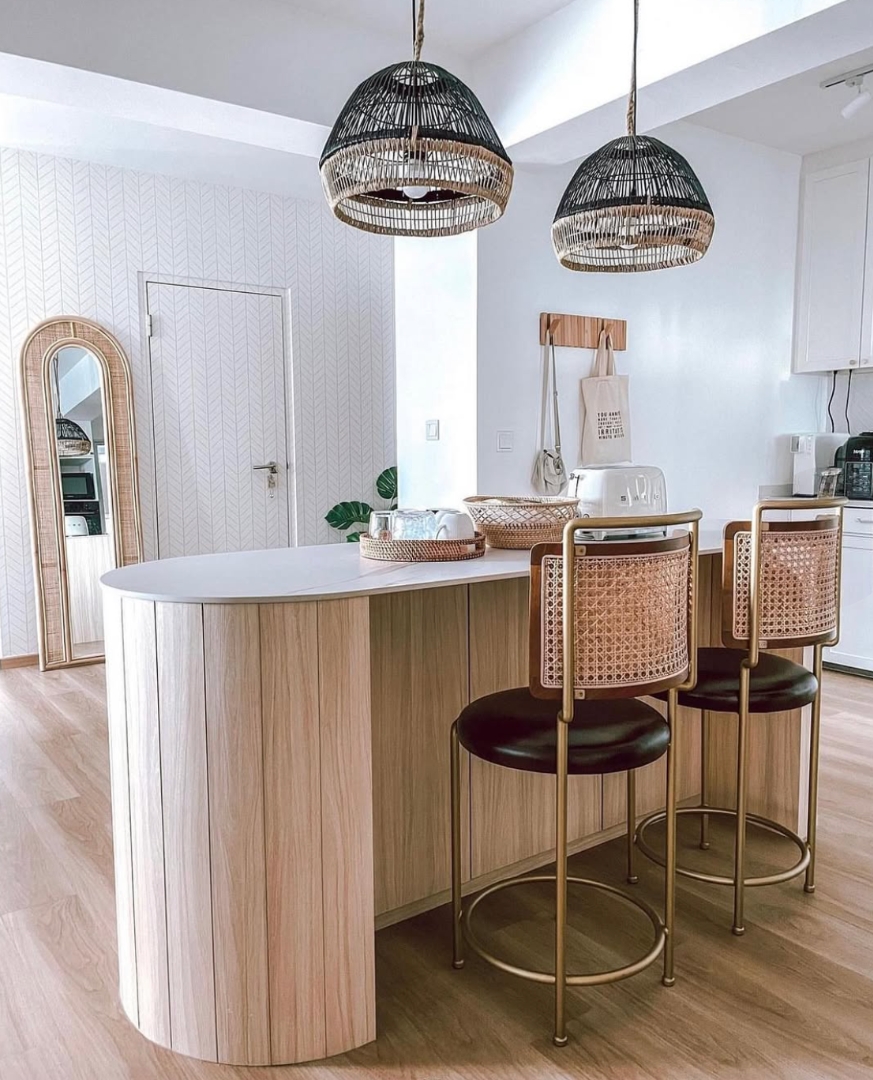
Featured: Herringbone Hand-Drawn Wallpaper
For more ways to make the shelter disappear, see our guide to camouflaging your bomb shelter with wallpaper.
Dry Kitchen Walls
A dry kitchen is one of the best uses of wallpaper in a flat, since the wall between the upper and lower cabinets is small, highly visible and expensive to tile. Choose a washable design and keep it away from the hob splashback and the sink, where heat and standing water will eventually win. Where cabinets break the wall into narrow strips, a small, dense repeat is the safer choice, because a large motif ends up cropped into fragments. Finish the paper behind the top edge of the counter and under the lip of the wall units, so there is no exposed cut edge to catch steam.
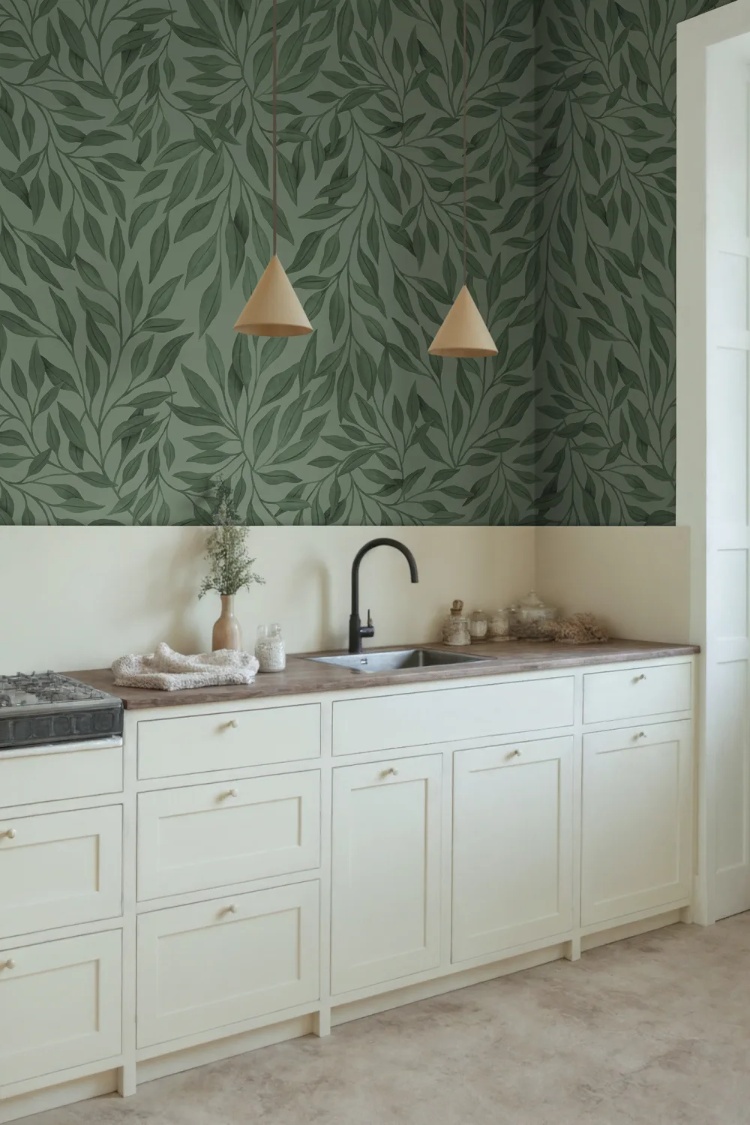
Featured: Willow, Botanical Pattern Wallpaper
For layout and design ideas before you pick a pattern, read our guide to designing your dry kitchen with wallpaper, then browse the kitchen wallpaper collection.
Wainscotting and Panelled Walls
Wallpaper above wainscotting is a classic pairing, and the measurement is the part people get wrong. Measure from the top of the dado rail or panelling to the ceiling, not from the floor, and order to that height. Plan which part of the pattern lands at the rail too: a design with a strong horizontal element looks deliberate when it sits a few centimetres clear of the moulding and awkward when it is sliced in half. Paper first and fit the moulding afterwards where you can, since cutting a clean line against an already installed rail is fiddly, and caulking the join afterwards hides any waver.

Featured: An Old World Arboretum, Watercolour Mural Wallpaper
Our post on wainscotting tips and how to use it at home covers the panel heights and styles that suit Singapore ceiling heights.
Sloped Ceilings, Beams and Odd Angles
Attic rooms, stairwell walls and the bulkheads that hide aircon ducting all share the same problem: there is no reliable vertical or horizontal line to work from. An installer starts by marking a true plumb line rather than trusting the wall edge, then works outward from it, so any drift ends up tucked into a corner instead of running visibly down the middle of the wall. Angled cuts at a sloped ceiling need matching on both sides of the apex, which is slow work and the main reason stairwell and loft jobs are quoted individually.
Corners, Alcoves and Recesses
Almost no corner in a flat is perfectly square, which is why wallpaper is never wrapped around one in a single piece. Each length is cut at the corner and overlapped slightly onto the next wall, keeping the new drop plumb instead of inheriting the lean of the old one. Alcoves either side of a chimney breast or a bay window need the same treatment, with a fresh plumb line for each face. Our guide to wallpapering internal and external corners shows how the joins are made.
Sockets, Switches, Windows and Doors
These are the details that give a DIY job away. Power goes off at the mains before any paper goes near a socket, the faceplate comes off, the paper goes over the opening and the cut is made so the plate covers the edge when it is screwed back on. Around a window reveal or a door frame, the paper is hung oversized and trimmed in place with a sharp blade against a straight edge, changing the blade often so it cuts rather than tears. Both are covered step by step in our guides on wallpapering around sockets and switches and wallpapering around windows and doors.
Ceilings
Papering a ceiling turns a feature wall into a whole room, and it is the one job we would always hand to a professional. The paper has to be supported along its full length while it is positioned, which realistically needs two people and a proper platform. Carrying a design up the wall and across the ceiling also means the join at the top has to line up, so order both surfaces together and have them hung in one visit.
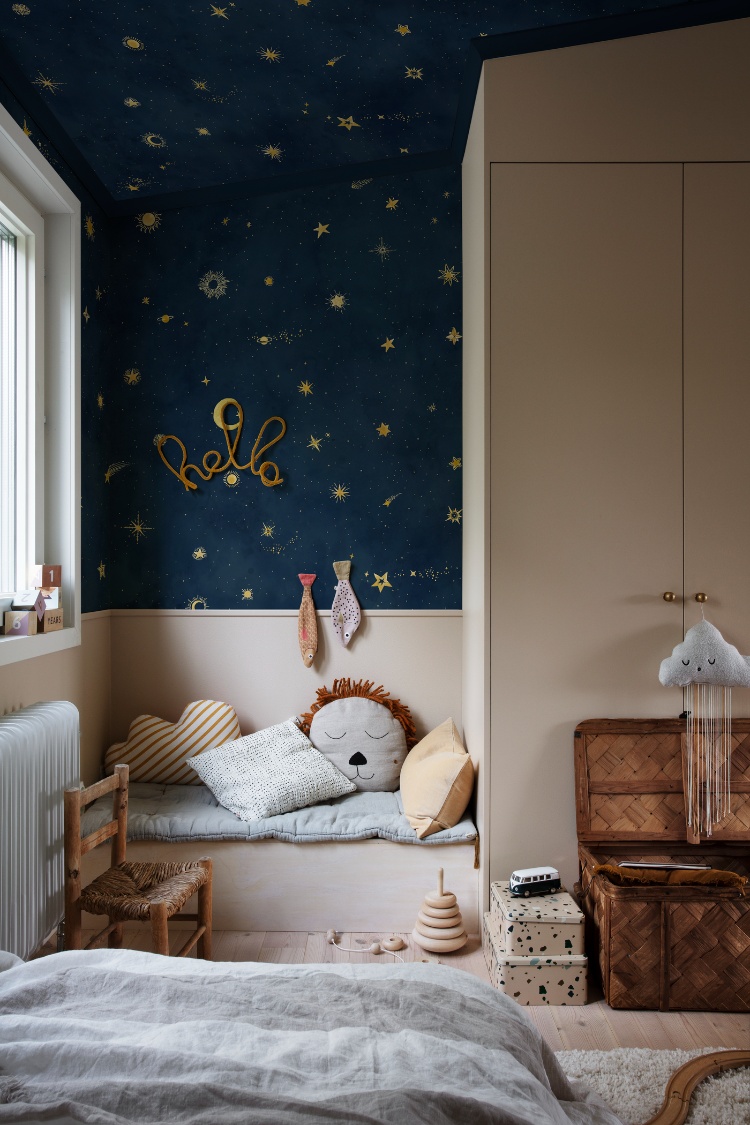
Featured: Starry Sky, Pattern Wallpaper
Read how to wallpaper a ceiling before you decide, and browse designs made for the fifth wall in our ceiling wallpaper collection.
Every one of these jobs is covered in more detail in our how-to guides for wallpaper, including preparing your walls, hanging peel and stick wallpaper and removing wallpaper when it is time for a change.
Why Choose Our Wallpaper
Every design is printed in Europe on non-woven paper reinforced with nylon fibres, and cut to your wall rather than sold by the roll. Non-woven is also the reason installation goes smoothly: the paste goes onto the wall rather than onto the paper, so it does not stretch or shrink as it dries, and it comes away cleanly in full strips when you eventually redecorate.
- Made to measure, never sold by the roll. Every design is printed to the exact height and width of your wall, so there is no roll calculator to puzzle over and no spare rolls left in the store room.
- Priced by the square metre, which means you pay for the wall you actually have instead of rounding up to the next full roll.
- Matte and non-reflective, so a feature wall reads as warm and soft rather than glaring back at your downlights.
- VOC-free inks and PVC-free, breathable paper, which matters in a closed, air-conditioned flat and in a child's room.
- Antimicrobial protection, helping resist the mould and mildew that Singapore humidity encourages.
- Washable, so everyday marks and water stains wipe off with a damp cloth or sponge.
- Colourfast, keeping the design rich rather than faded in a bright, sun-facing room.
- Fire resilient, meeting European fire safety standard EN ISO 11925-2.
Read more about our wallpaper materials, or work through the ultimate guide to wallpaper for the questions we are asked most.
Wallpaper Installation in Singapore: Common Questions
How much does a wallpaper installer cost in Singapore?
Our installation starts at S$215 for a wall under 6m² and rises by wall area, reaching S$1,100 for a 55 to 60m² job. The fee is a flat charge for the whole wall, not an hourly rate, and walls above 60m² are quoted individually.
Do you install wallpaper bought from another shop?
No. Installation is an optional add-on for wallpaper bought from Hello Circus, which lets us stand behind both the material and the workmanship with a one-year guarantee.
Can I add installation after I have placed my order?
Yes. Installation can be added on the product page before the wallpaper goes into your cart, but if you have already ordered, email your order number to [email protected] and we will send you a separate invoice for the installation.
Is wallpaper allowed in an HDB flat?
Yes. Wallpapering is a finish rather than a structural change, so it does not need an HDB renovation permit. Our non-woven wallpaper is also strippable, which keeps things simple if you are renting or planning to sell.
Can you wallpaper a bomb shelter door?
Yes, and it is one of the most popular requests we get. Wallpaper adds no weight and needs no fixings, so it suits the shelter door and the wall around it. Keep the door notice and the ventilation plates clear, never drill or hack the shelter walls, and check SCDF's current permitted works list before you start.
How long does wallpaper installation take?
A single feature wall usually takes one to two hours. Multiple walls, ceilings and rooms that need preparation take longer. Your installer will confirm a time slot and give you an estimate when the date is arranged.
Can wallpaper go in a bathroom or kitchen in Singapore?
It can, away from direct water. Keep it off the shower wall and the splashback behind the hob, make sure the room ventilates properly, and wipe down any splashes rather than leaving them to soak in. Our bathroom wallpaper and kitchen wallpaper collection pages answer the common questions for each room.
How long does my wallpaper take to arrive?
Every design is printed to your measurements, so orders are dispatched within 10 to 15 business days, and Singapore delivery takes a further 3 to 5 business days. We arrange your installation date once the wallpaper has arrived.
Ready to Get Your Wall Done?
Start with the design, since that is the part you will live with. Explore our full wallpaper collection or see what other homes are choosing in our best selling wallpapers, enter your wall measurements for an instant price, and tick installation before you add it to your cart if you would rather leave the ladder work to someone else.
Still torn between two designs? Hit the Buy Sample button on each product page and see how they look on your own wall, in your own light, before you commit.
Questions about a tricky wall, a stairwell or a whole-room job? Get in touch with your measurements and a photo, and we will tell you what it takes.



